Showing posts with label metalwork. Show all posts

Wednesday, July 13, 2011

Tank fab for GL1000

Tank build for GL1000.  The tank's shape looks simple from the outside, but its actually pretty tricky underneath. The tank Honda designed sat below the seat between the rear wheel and transmission case. That puts the center of gravity lower and to the rear (when it's filled), and protects the tank in the event of a crash between the frame rails.
I've thrown all that good design out and built one to sit where it usually does, on top of the frame between the rider's knees! I wanted to move the battery into the space where the old tank lived, just in front of the rear wheel and centered. The old tank is rusty and will kill the carburetors. 
As it stands

I expected A FEW leaks after welding up, but it was leaking like a sieve. I didn't bother to count.
Flux core TIG welding is very dirty. There are lots of pin holes and potentials for voids. This also has a lot to do with welding technique and prepping the weld areas correctly, but.. 

 
Filler Neck welded in

I'm grinding the welds down flat and laying another wider & hotter bead over them. So far this has filled any voids and killed leaks along the seams. I'm using pressurized air and soap to find pinholes, then grinding and laying a wide bead over the area. I don't think I could do such wide, flat beads with as much penetration if the first pass welds were not done. The top and bottom halves were shaped and tacked. Then the tacks were stitched together at the same heat, alternating sides to keep distortion low. All the tacks and stitches are hammered flat, then stress relieved. I did the tacking and stitching at the lowest heat with the wire feed a little higher than normal. Once all of the leaks are out and the pressure holds at 50PSI for a few hours, I'll etch the inside with a solution of phosphoric acid in water, dry it with MEK and use the liquid polymer liner to seal it. Then the outside will get smoothed/sanded and painted some color. 

Tuesday, June 14, 2011

Nibbles

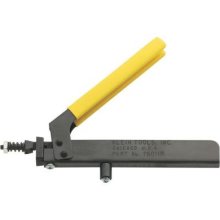
Klien Nibbler

This is the best tool I've found in a long time. It's a sheet metal nibbler. It's for nibbling sheet metal, rather than shearing. I have shears, I have nibblers. I have 2 air nibblers. They are for getting the job done fast. They can nibble in square feet per minute measurements. This Klien nibbler is perfectly designed. It requires very little effort to nibble through 20 gauge steel. It's not the quickest, shears are probably quicker, but it does very clean, precise cuts. You can drill a small hole and start right in the middle of a sheet (try that with shears), you can cut tight radius curves, and it wont raise an edge like a can opener the way a shear does.
I think this tool is made in Lincolnwood, IL just around the corner from me. The design is simple and perfect. The materials, coatings and finish are perfect. The heat treating of the blade is perfect. This tool is designed and made by experts, in America. The parts are all high quality, adjustable and replaceable or easily repaired.
Almost every time I go to the hardware store I see a deal on some Husky or other house brand tool which is too good to be true. $9 complete 1/4" socket set, $4.99 ratcheting screwdriver set, etc.
The products in this container may come from China, Malaysia, Indonesia, Taiwan, Mexico or the USA.
The quality of the house brand tool varies as widely as its origin. It is most likely to break, but it carries a hassle free lifetime replacement warranty. The cheaper manufactures believe that brand loyalty is easily gained by convenience, low price and replacing any defective product for free. Customer Service!
Everyone replaces broken tools for free nowadays. The material cost of a tool or part is low compared to customer satisfaction. I find broken 10mm sockets all over the garage. I break 10mm sockets more than anything else. All of the broken ones are house brand X, none of them are American made SnapOn, MAC, MTF, SK or Klien tools. Broken tools waste time, which is worth more than money. I think.
The saved time and satisfaction of using a well made tool are worth the extra money, as is knowing that Your Country (America) still makes the best tools available in your country.
German tools are great, but we all know that it was the American industrialists who helped them out after WW1 that made them that way.